

What is the ASHRAE Psychrometric Chart? A Complete Scientific Guide to Psychrometric Chart and Air Properties in HVAC
Introduction
Understanding psychrometric chart and air properties is one of the most important foundations in HVAC engineering. While many beginners focus only on temperature control, real HVAC design depends on analyzing how air behaves under different conditions of temperature and moisture.
This is where the ASHRAE psychrometric chart becomes a powerful tool. It allows engineers to visualize air properties, study thermal processes, and design efficient HVAC systems based on scientific principles.
In this article, we will provide a complete and detailed explanation of the psychrometric chart and air properties, including definitions, design parameters, and real HVAC applications.
What is the ASHRAE Psychrometric Chart?
The ASHRAE psychrometric chart is a graphical representation of the physical and thermodynamic properties of air. It shows the relationships between temperature, humidity, and other air properties in a visual format.
This chart is developed based on standards from ASHRAE (American Society of Heating, Refrigerating and Air-Conditioning Engineers), making it a global reference in HVAC engineering.
Using the psychrometric chart, engineers can:
- Analyze air conditions
- Study heating and cooling processes
- Calculate humidity and moisture content
- Design HVAC systems efficiently
Why is the Psychrometric Chart Important in HVAC?
The psychrometric chart is essential because HVAC systems do not just control temperature—they control air conditions as a whole.
Key reasons for its importance:
- Helps maintain thermal comfort
- Improves indoor air quality
- Assists in accurate load calculations
- Enables energy-efficient system design
- Prevents issues like condensation and mold
Without understanding the psychrometric chart and air properties, it is impossible to design a professional HVAC system.
Air Properties in HVAC Systems
Air in HVAC is considered a mixture of dry air and water vapor. The behavior of this mixture defines comfort and system performance.
Below are the most important air properties:
1. Dry Air
Dry air is air without water vapor. It is a theoretical concept used as a reference in calculations.
2. Moist Air
Moist air is the actual air we deal with in HVAC systems. It consists of:
- Dry air
- Water vapor
This mixture determines humidity levels and affects cooling performance.
3. Saturated Air
Saturated air is air that contains the maximum possible amount of water vapor at a specific temperature.
- Relative humidity = 100%
- Any additional moisture will condense
This condition is critical in studying condensation and dew formation.
4. Dry Bulb Temperature (DBT)
Dry bulb temperature is the temperature measured by a standard thermometer.
- Represents sensible heat
- Does not account for moisture
It is one of the main parameters used in HVAC design.
5. Wet Bulb Temperature (WBT)
Wet bulb temperature is measured using a thermometer covered with a wet cloth.
- Reflects evaporative cooling effect
- Always lower than or equal to DBT
- Used to determine humidity
6. Dew Point Temperature
Dew point is the temperature at which air becomes saturated and condensation begins.
- Indicates moisture content
- Important for preventing condensation in ducts and surfaces
7. Relative Humidity (RH)
Relative humidity is the ratio of actual moisture to maximum moisture capacity of air.
- Expressed as percentage
- Comfort range: 50% ± 5%
8. Humidity Ratio
Humidity ratio is the mass of water vapor per unit mass of dry air.
- Measured in kg/kg
- Used in engineering calculations
9. Specific Volume
Specific volume is the volume occupied by one kilogram of air.
- Important in duct sizing
- Changes with temperature and pressure
10. Room Sensible Heat Factor (RSHF)
RSHF represents the ratio of sensible heat to total heat.
- Sensible heat affects temperature only
- Used in system selection
11. Room Latent Heat Factor (RLHF)
Latent heat factor represents the portion of heat used to change moisture content.
- Important for humidity control
12. Room Total Heat
Total heat is the sum of:
- Sensible heat
- Latent heat
This value is used to determine the total cooling load.
HVAC Design Parameters
Proper HVAC design depends on selecting correct indoor and outdoor conditions.
Indoor Design Parameters
Indoor conditions are selected based on human comfort standards.
Typical values:
- Dry Bulb Temperature: 24°C ± 2°C
- Relative Humidity: 50% ± 5%
These conditions provide:
- Comfortable environment
- Balanced humidity
- Healthy air quality
Outdoor Design Parameters
Outdoor conditions depend on the geographical location.
They include:
- Dry Bulb Temperature (DBT)
- Wet Bulb Temperature (WBT)
These values are used for:
- Load calculations
- Equipment sizing
- System efficiency analysis
Structure of the Psychrometric Chart
The psychrometric chart contains several lines and curves representing different air properties.
Key components include:
Dry Bulb Temperature Lines
- Vertical lines
- Represent air temperature
Humidity Ratio Lines
- Horizontal lines
- Represent moisture content
Relative Humidity Curves
- Curved lines
- Range from 0% to 100%
Wet Bulb Temperature Lines
- Diagonal lines
- Represent combined heat and moisture effect
Enthalpy Lines
- Show total heat content
- Used in energy calculations
How to Use the Psychrometric Chart
To use the chart:
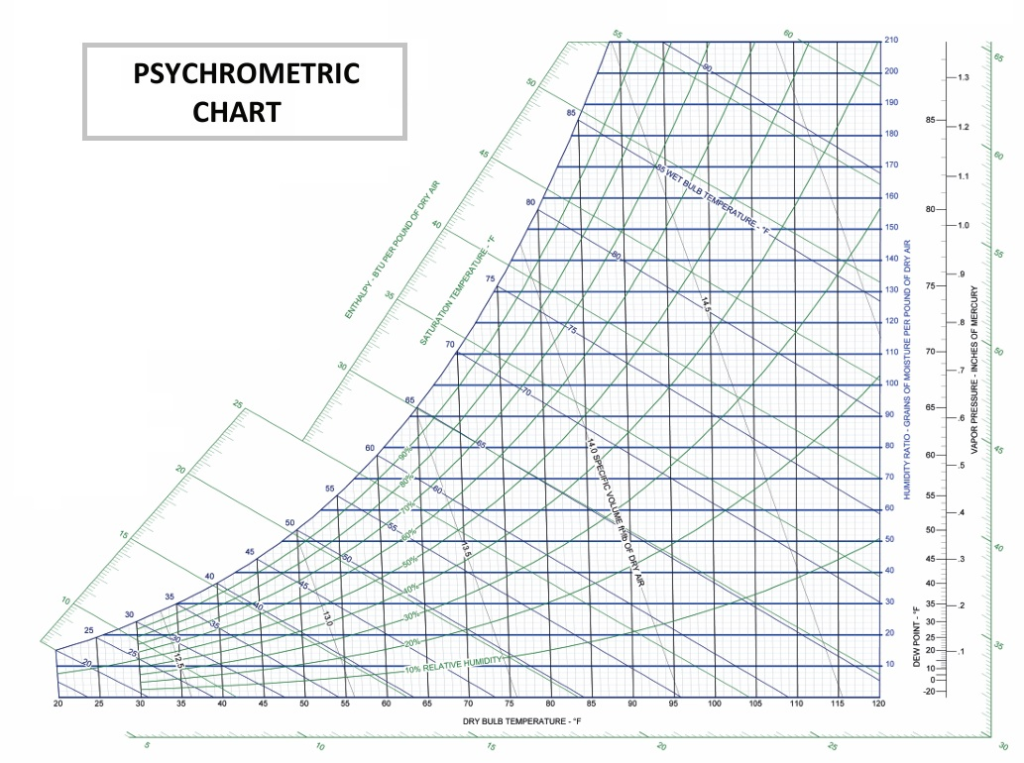
- Identify dry bulb temperature
- Locate relative humidity
- Find the intersection point
- Read other properties (humidity ratio, enthalpy, etc.)
This point represents the state of air.
HVAC Processes on the Psychrometric Chart
Different HVAC processes can be visualized on the chart:
Cooling and Dehumidification
- Moves downward and to the left
- Reduces temperature and moisture
Heating
- Moves horizontally to the right
- Increases temperature only
Humidification
- Moves upward
- Increases moisture
Dehumidification
- Moves downward
- Reduces moisture
Practical Applications in HVAC
Understanding psychrometric chart and air properties helps in:
- Designing air conditioning systems
- Calculating cooling loads
- Improving indoor air quality
- Preventing condensation
- Enhancing energy efficiency
Common Mistakes in Understanding Air Properties
Some common errors include:
- Ignoring humidity in design
- Confusing DBT with WBT
- Not considering outdoor conditions
- Incorrect use of psychrometric chart
Avoiding these mistakes leads to better HVAC performance.
Conclusion
So, what is the ASHRAE psychrometric chart and why are air properties important?
The psychrometric chart is a powerful engineering tool that helps visualize and analyze air conditions. Combined with a deep understanding of air properties, it allows HVAC engineers to design efficient, comfortable, and reliable systems.
Mastering psychrometric chart and air properties is essential for anyone working in HVAC. It transforms theoretical knowledge into practical design skills and ensures that indoor environments meet the highest standards of comfort and efficiency.
If you are serious about HVAC, learning how to read and use the psychrometric chart is not optional—it is a must.
